
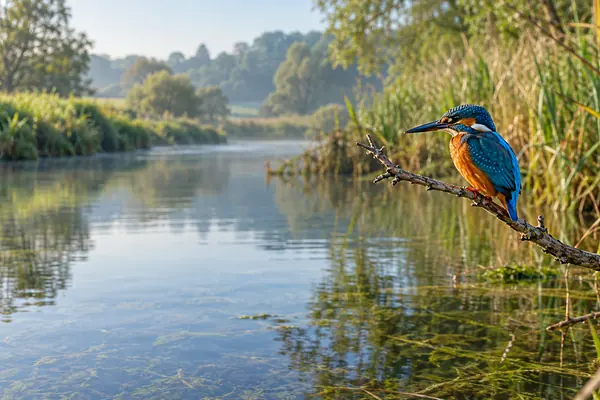
COLOUR
Blue without blue
The RSPB says a kingfisher's feathers contain no blue pigment. They are a dull brown; the blue comes from tiny structures in the feathers scattering the light.
When to lookA RIVERSIDE GUIDE
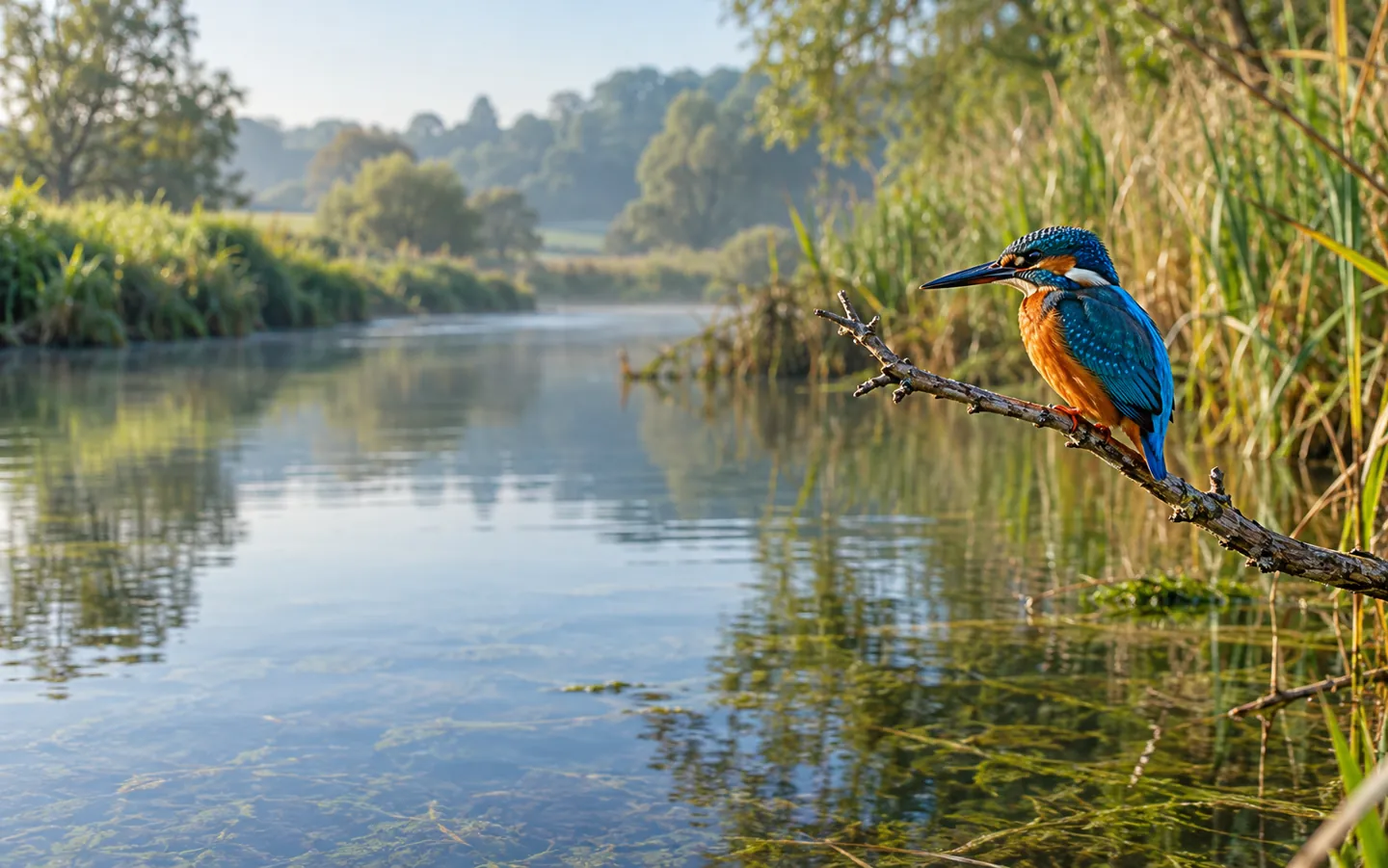
Most people hear a kingfisher before they see one.
It lives on most rivers, canals and lakes in the UK, yet a bird this bright can sit unnoticed on a branch. The BTO says a piping call is usually the first clue; then comes a low blue streak over the water.
AUGUST the best month to try
THE SHORT ANSWER
Only slightly larger than a robin, nearly twice as heavy.
Three things that make the kingfisher what it is.
COLOUR
The RSPB says a kingfisher's feathers contain no blue pigment. They are a dull brown; the blue comes from tiny structures in the feathers scattering the light.
When to lookFISHING
It dives from a riverside perch for small fish such as minnows. A transparent third eyelid helps it keep sight of its target as it hits the water.
See the numbersNESTING
Pairs dig into steep earth banks. At WWT Slimbridge the nest burrow can be up to 1 metre long, rising slightly from the entrance hole.
How to spot oneA QUICK SEASON CHECK
Pick a time of year to see what the kingfisher is doing and how good your chances are. The bar shows how strongly the sources point to that season.
Based on RSPB, BTO, Woodland Trust and WWT Slimbridge information. Kingfishers are resident all year in most of the UK.
TWO NUMBERS WORTH KNOWING
One figure on how many breed in the UK,
one on how hard the parents work.
3,850 pairs
Breeding pairs in the UK (2016 estimate)
The BTO puts the UK breeding population at 3,850 pairs. Numbers rise and fall, and the BTO says severe winter weather may be the main driver of change.
UK BREEDING · BTO
up to 100
Fish delivered to a nest in a day
WWT Slimbridge says both parents feed the chicks in the nest hole with up to a hundred fish a day, starting small and bringing bigger fish as the chicks grow.
FEEDING CHICKS · WWT
Kingfishers are green-listed in the UK, meaning they are not of conservation concern. The BTO puts the change in the UK breeding population from 1995 to 2024 at minus 7 per cent, which it classes as stable.
FOUR WAYS TO IMPROVE YOUR CHANCES
You do not need special kit. You need the right kind of water, a quiet spot and a little patience.
Rivers, canals and lakes where the water is clear or slow flowing make it easy for a kingfisher to spot fish, and for you to spot the kingfisher.
The BTO says you will usually be alerted by its piping call before you see the bird itself.
Check low-hanging branches and posts at the water's edge, where a kingfisher waits before it dives.
Kingfishers have extra legal protection while nesting. Watch from a distance and never linger by a nest bank.

HARD WINTERS

The RSPB says kingfishers are vulnerable to hard winters, and the BTO links swings in their numbers mainly to severe winter weather, with water quality and the supply of their favourite prey also playing a part.
The birds recover. The BTO says winter range grew by 45.7 per cent between the early 1980s, a low point after several cold winters, and 2007 to 2011.
Questions
Not especially. They are green-listed and found on most rivers, canals and lakes apart from northern Scotland; the BTO estimates 3,850 breeding pairs. They are just hard to spot.
Look at the beak. The RSPB says the male's beak is completely black, while the female's lower half is orangey-pink.
Their feathers have no blue pigment. The RSPB says they are actually a dull brown, and the blue comes from the way tiny structures in the feathers scatter the light.
Not long. The BTO gives a typical life expectancy of 2 years for a bird that reaches breeding age, which is usually at 1 year old. The oldest ringed bird reached 4 years and 6 months.
Only from a distance. Kingfishers are Schedule 1 birds, and GOV.UK says it is an offence to disturb them while they are nesting or near a nest with young, without a licence from Natural England.
Sources
ABOUT THIS NAME
doodlekings.com is part of the DoodleSale portfolio. It isn't in an auction right now, but you can ask about leasing it.